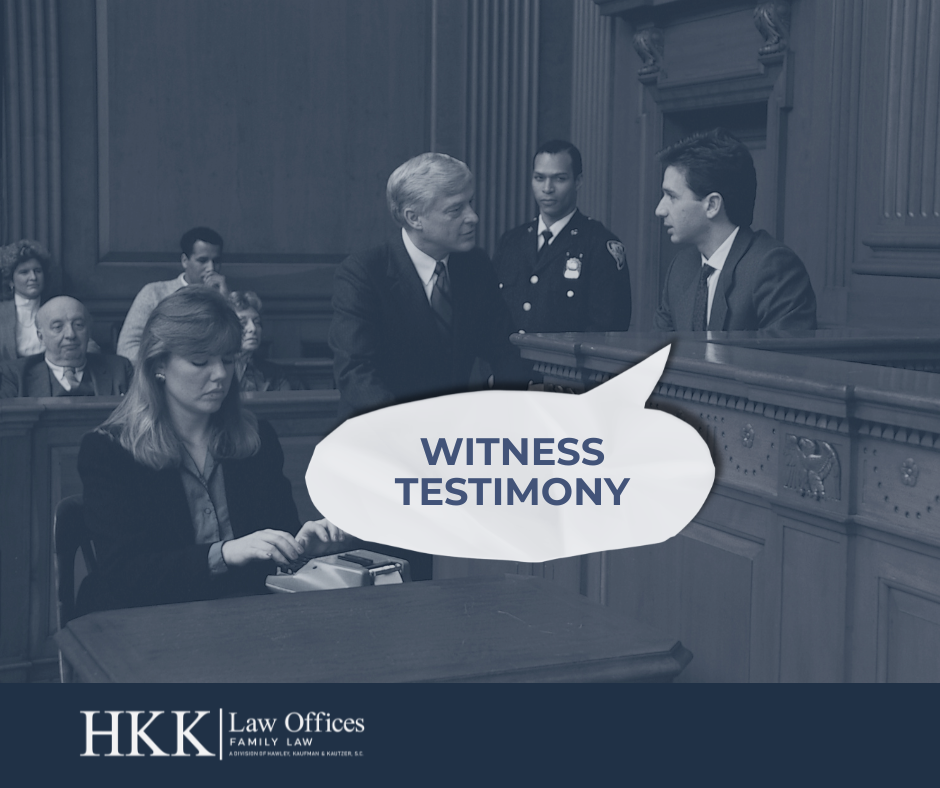
Understanding Witness Testimony in Wisconsin Family Law

Can a Witness Write a Letter Instead of Testifying in Family Court? The short answer: probably not.
Family law matters include, but are not limited to, divorces, child custody, child support, paternity, guardianship, termination of parental rights, and adoption. Family law cases involve what matters most: one’s children, finances, and dignity. As a result, the parties involved often find themselves in disputes.
The Role of Witnesses in Court
At a hearing, a court official reviews evidence from both parties on the issues at hand. Evidence consists of testimony, documents, pictures, videos, recordings, and other items. Testimony can come from the parties, or other witnesses who have firsthand knowledge of events. This means that the witnesses observed something, heard it, smelled it, or touched it.
Divorces are complex, and courts may need witnesses to resolve issues related to child custody, child placement, child support, spousal maintenance, and the division of property.
Witnesses in Child Custody & Placement Cases
In custody and placement cases, parents are usually fighting over who makes decisions for the child and how much time the child spends with each parent. Wisconsin statutes ask a court to decide on the issues after considering the overall best interest of the child. Wisconsin statutes cite several factors to help the court determine what is in a child’s best interest. One of the factors asks the court to consider whether a parent has a substantial issue with alcohol or drug abuse.
A witness can be helpful in deciding this issue. While a spouse can testify and provide evidence of substance abuse concerns, other witnesses may have relevant observations to support that notion or dispel it. For example, a witness could testify to making observations of one parent who overly consumes alcohol and then drives with a child in the vehicle.
The witness would need to testify at a hearing. A letter would not be sufficient as the parent accused of substance abuse would have no opportunity to confront the witness about the witness’ observations. If we allowed parties to submit letters, we would basically be asking the court to assume that everything in the letter is true. That is not how our system works.
In the hypothetical here, attorneys could question the witness about the event – who, what, where, when, how, etc. It would be up to the court to determine, based on the questions asked by the witnesses, and the answers, what weight to put on the testimony. In other words, is the witness credible, and based on the story told by the witness, is it relevant to the court’s decision on whether the accused has a substantial issue with substance abuse, and whether that issue bears on the child’s best interest.
Witnesses in Property Division Cases
Another example is real estate. In divorces, spouses must decide what to do about the marital residence they acquired during the marriage. Should the home be sold, and if not, who is awarded the home?
When real estate is awarded to one spouse, the parties may disagree over the value of the home. Spouses may hire certified real estate appraisers to determine the value of their property based on their opinions. An appraiser writes a report and often must testify at a trial about the process they used to evaluate the property, and why they appraised the home at the value cited in the report.
It would be improper to simply allow a court to receive a report or letter from the appraiser without testimony. Why? It assumes that everything in the report is accurate and that the court should simply accept it. It also prevents the other spouse from questioning the appraiser and pointing out mistakes that could change the home’s final value.
Why Witnesses Are Often Reluctant
Many times, family, friends, and professionals do not want to get involved in family law matters. They see it as “choosing sides”. However, this is not the case.
For example, in personal injury matters, witnesses are often people who were bystanders and who happened to be present at the event. The witness saw the car crash while stopped at a red light, or the witness is a police officer who arrived at the scene and observed the location of the vehicles after the accident.
In personal injury cases, witnesses seem to understand that their observations are just that—observations that will help a fact finder determine negligence. The witnesses are not concerned about what one party thinks about them. They just want to make sure the fact finder has the correct information to make the right decision.
In family law, witnesses often feel too involved in the matter. For example, teachers, counselors, family members, and friends of the parents or children involved do not want to insert themselves into what they believe is a private matter. They become concerned that others will see them as ‘choosing sides’ or ‘biased’.
The reality is that these people typically have relevant information that helps to solve the “he said, she said” that often occurs in family matters. When two spouses are testifying about an event, and the testimony is exactly opposite, who is the court to believe? Independent witnesses such as teachers, coaches, and counselors, are often privy to important events. Just like a person witnessing an auto accident, they may have witnessed domestic abuse, substance abuse, emotional abuse, child abuse, financial abuse, or something else. They are not picking sides. The witness just happened to be there when someone said or did something.
When is a Letter Enough?
Allowing witnesses to submit a letter is often insufficient. If the witness saw something or heard something, courts should hold them to the same standard as a witness in an auto accident.
When is a letter or report good enough? Typically, this only occurs by agreement. If both parties agree that the court may receive a written letter or report into evidence without supporting testimony, the court may accept it. This happens occasionally and usually occurs when the circumstances are uncontested.
There are other circumstances in which a court can receive a report, but that gets more into the weeds and involves exceptions to evidentiary rules. This gets complex and is something you should discuss with your attorney. At the end of the day, if you want to prove a fact, you should be prepared to have witnesses testify about their observations.
Final Thoughts
Although witnesses may not want to become involved, they are already involved as fact witnesses. That is not their fault, or yours. They simply were present when the event happened. If the event is relevant to a court’s decision on child custody or your finances, you must prepare to make arrangements for the witness to testify in court.
You are not alone in this process. If you are working through a family law matter and want to learn more about your options, please contact us or schedule a consultation with one of our family law attorneys.