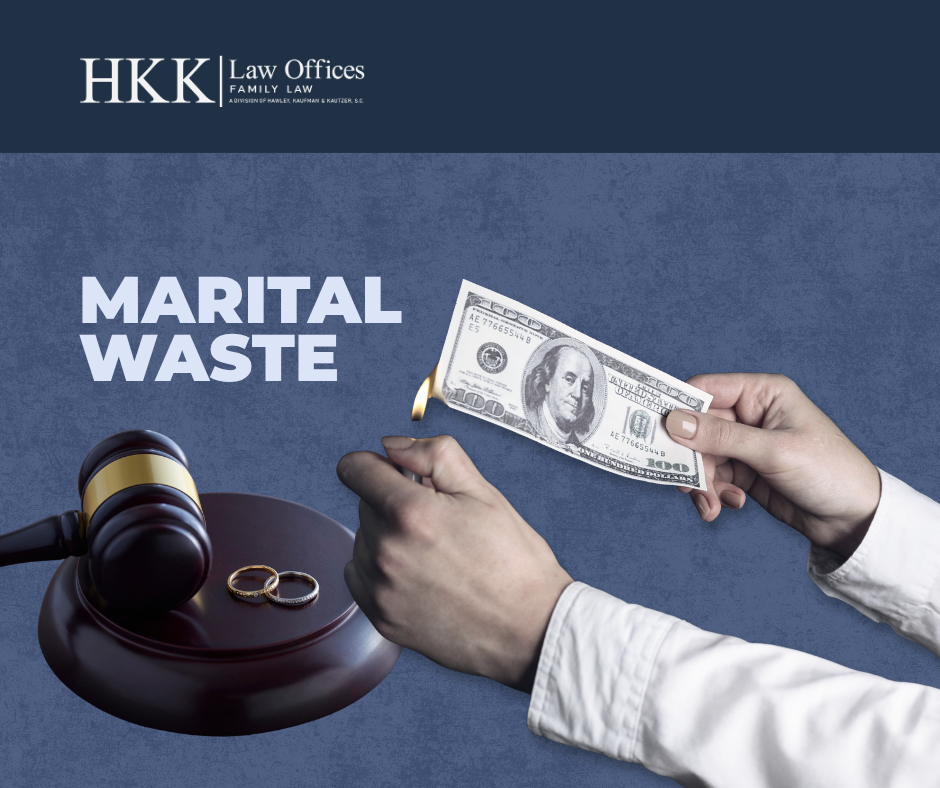
What Counts as Marital Waste in Wisconsin?
What happens when a spouse gives away marital assets before divorce?
John and Alex have been married for 8 years, and have accumulated around $200,000 in marital assets. Now, they are going through a divorce and must gather their financial information to determine how the marital property will be divided.
While reviewing their financial records, Alex discovers some withdrawals from their joint marital account that were made several months ago. Alex doesn’t recall making these transactions herself and cannot remember why these amounts would be withdrawn. After further investigation, Alex realizes that John has been giving money to his brother and parents without discussing it with her first.
Alex is furious and left wondering: Can John give away our marital assets months before our divorce??
In John and Alex’s situation, the gifts that John gave to his family may be considered marital waste under Wisconsin law. However, whether or not the gifts truly qualify depends on the amount(s) gifted and the circumstances under which the gifts were given. In this week’s blog, I will explain what circumstances constitute marital waste and how Wisconsin law handles these issues.

Important Definitions
Before we dive into the legal explanations for determining marital waste, it’s important to understand the concepts listed below.
- Marital Property: According to Wis. Stat. § 766.31, “all property of spouses is marital property except that which is classified otherwise.” All property of spouses is presumed to be marital property. Property can include bank and investment accounts, retirement accounts, business interests, real estate, and other assets and debts acquired during the marriage.
- Marital Waste: Marital waste involves the transfer, squandering, or disposal of assets for inadequate consideration or in a manner that diminishes the marital estate.
- Property Division: Property division is a significant part of any divorce, legal separation or annulment. In Wisconsin, the law presumes that the value of all property and debts should be divided equally amongst the parties. The process of property division includes identifying, valuing, and determining who gets what and how much of each piece of property.
- “Burden of Proof”: The legal obligation of a party to provide enough evidence to support their claim or argument.
Legal Criteria for Marital Waste
To be considered marital waste under Wis. Stat. §767.63, , the transfer must (1) occur within one year prior to the filing or during the marriage, whichever is shorter; (2) involve inadequate consideration or be unaccounted for; and (3) involve intentional squandering of marital assets as clarified in Hauge v. Hauge, 145 Wis. 2d 600, 604 (Ct. App. 1988).
1. Temporal Event – Burdens of Proof
Under Zabel v. Zabel, 210 Wis. 2d 336, 565 N.W.2d 240 (Ct. App. 1997), the timeline matters when determining the burden of proof for claims of marital waste.
If one spouse transfers or gives away $500 or more within one year of filing for divorce…
- The law presumes that those assets are subject to division as marital property.
- The spouse who made the transfers must rebut (overcome) that presumption by proving why those assets should not be considered marital property.
- In this situation, the accused spouse has the burden of proof.
If these transfers of $500 or more occurred greater than one year before the divorce was filed…
- The automatic legal presumption that those assets should be divided as marital property DOES NOT apply.
- In this situation, the accusing spouse would have the burden of proof. They would have to be the one to prove that marital waste has occurred.
2. Nature of the Transfers
If you are within one year of the filing and the transferred assets are $500 or more, the transferring party bears the burden. This means they have to show that the payments were NOT “wasted, given away, or otherwise unaccounted for.” Wis. Stat. §767.63. If the spouse alleging the waste bears the burden, they have to show that the payments were “wasted, given away, or otherwise unaccounted for.” Wis. Stat. §767.63.
3. Intent – No Intentional Squandering
As held in Hauge, marital waste must involve the intentional squandering or destruction of marital assets. The court has a lot of deference to determine what is and what is not marital waste. These decisions are very fact based and vary case by case.
Marital Waste Examples:
- When a spouse spends marital funds or gives away property to family members or someone they are having an affair with.
- Gambling.
- Money spent on alcohol or other addictions.
Remedies for Improper Gifts / Marital Waste
How can I be compensated for the wasted/disposed of property? If one spouse gives away marital property during the marriage and does not comply with s. 766.53, the other spouse may be able to take legal action to recover the property. They may bring the action against the donating spouse, the gift recipient or both.
During a divorce, a successful marital waste claim can result in a higher equalization payment from the spouse who orchestrated the marital waste. Conversely, if the marital waste spouse was originally owed an equalization payment, they may receive no equalization or a lowered amount, depending on the circumstances.

Recovering the Disposed of Property
1. Act quickly. The spouse who wants to challenge the gift must file an action by the earliest of:
- One year after they find out about the gift
- One year after the marriage is dissolved (for example, after a divorce)
- The deadline for filing a claim against the deceased spouse’s estate under Wisconsin law, if one of the spouses dies
2. The time of the recovery matters…a lot.
If the recovery occurs during marriage, it is marital property. If the recovery occurs after a dissolution or the death of either spouse, the recovery is limited to 50 percent of the recovery that would have been available if the recovery had occurred during marriage.
- For example: In John and Alex’s story from the beginning of the blog, let’s say John gave $20,000 in marital assets to his brother. If Alex recovers the $20,000 before their divorce is finalized, the entire amount would be recovered. However, if Alex recovers the $20,000 after the divorce (or after John’s death) she would only receive $10,000 (50% of $20,000).

Final Thoughts
Family law matters deal with some of the most important aspects of an individual’s life: their children, their finances, and their legacy. If you are going through a divorce or legal separation and you suspect marital waste has occurred, it is crucial that you speak with an attorney to understand your options and protect your rights.
If you have any additional questions or would like to learn more about your options, we invite you to contact HKK Law Offices. Our attorneys are available to meet by phone, video conference, or in person at our offices in Sheboygan, Mequon, and Random Lake. For more educational family law and estate planning content, check out our TikTok, YouTube, Instagram, Facebook, and LinkedIn platforms.
Disclaimer: This article is provided for general educational purposes only and should not be considered legal advice. Reading this article does not create an attorney-client relationship. Because every situation involves unique facts and circumstances, you should consult a qualified attorney regarding your specific legal needs.